Virginia Opioid Abatement Authority
Virginia Opioid Abatement Authority
When the opioid crisis swept through families, it left children behind. In Henrico County, a new program is making sure they don’t get lost.
Imagine, for a moment, that your family or a parent close to you is in crisis. A child cannot stay home. They have to go somewhere — tonight, maybe within the hour. The question is: where?
For most people, the answer is instinctive. Not a stranger’s house. Not a system, not foster care.
Grandma. A favorite aunt. The neighbor who has known your child since they were born. Someone who already loves them.
“Most people associate foster care with children entering into strangers’ homes,” said Grace Carpenter, Permanency Division Manager with Henrico County Department of Social Services. “If that were to happen to you or your family — how much better would it be for your child or yourself to go be with somebody you already know? Your grandma, your grandpa, your coach, your next-door neighbor. Somebody in your system who already knows you, who already cares for you and cares about what happens next. That’s what kinship care provides.”
That instinct — keep children with people who love them when a crisis occurs and parents needs to be separated — is the foundation of the Henrico County Kinship Navigator program, made possible through a Virginia Opioid Abatement Authority award to Henrico County.
What the Opioid Crisis Did to Families
The opioid epidemic didn’t only claim adults. It destabilized households, fractured families, and sent children into a child welfare system already stretched thin.
At the height of the crisis, the country experienced a 147% increase in the number of youth referred to foster care as a direct result of parental substance use disorder.
And the damage compounds.
Research from the National Institutes of Health found that approximately 50% of children who age out of the foster system go on to develop substance use disorder themselves.
“The light bulb went off,” said Mike Feinmel, Deputy County Manager for Public Safety in Henrico County. “(We needed to) create a pathway to use this funding to create a project that would attempt to remediate the impacts on our youth by the opioid crisis.”
The cycle was clear. The intervention point was clear. What was needed was a program with the clarity and the resources to act on both.
When Family Steps In
Most people, when they picture foster care, picture a stranger's home. A child placed with people they've never met, in a neighborhood they don't know, sleeping in a bed that doesn't feel like theirs.
Kinship care is something different. It's what happens when a grandmother, an aunt, a coach, or a longtime family friend steps forward and says: I'll take them. The child stays within their family system — connected to the people, the places, and the traditions that already shape who they are. The same school. The same holidays. The same faces at the dinner table.
That continuity isn't a luxury. For a child in crisis, it's a foundation for healing.
In Henrico County, the Kinship Navigator program exists to make sure that when family or close caregivers steps in, they don't have to figure it out alone.
The Gap Between Love and Preparation
Traditional foster parents go through an extensive process before a child ever enters their home.
Training. Home studies. Certifications. Months of preparation for the moment that eventually comes.
Kinship caregivers rarely get any of that. A grandmother gets a phone call at 9 p.m. A sibling gets a knock on the door. A family friend is asked, right now, tonight, to take in a child.
"Kinship caregivers are often stepping into a situation with an hour's notice, or sometimes even less,” said Gretchen Brown, Director of the Henrico County Department of Social Services and champion behind the kinship program. “They are less prepared to take care of children that are coming into their care and need some additional support — not only navigating the logistics, but also managing some of the family dynamics that come about when you're taking care of your daughter's child, or your brother or sister's child."
The love is already there. The infrastructure is not. And without support, even the most devoted caregiver can be overwhelmed by the logistics — school enrollment, court appearances, benefits navigation, paperwork — that arrive alongside the child.
"They're stepping into a position where they're asked to put the child's needs first and foremost, and that's where the Kinship Navigator is able to give them as much time as they truly deserve to be successful," Carpenter said.
What Kinship Navigator Does
The Kinship Navigator doesn't do one thing. They do whatever the family needs.
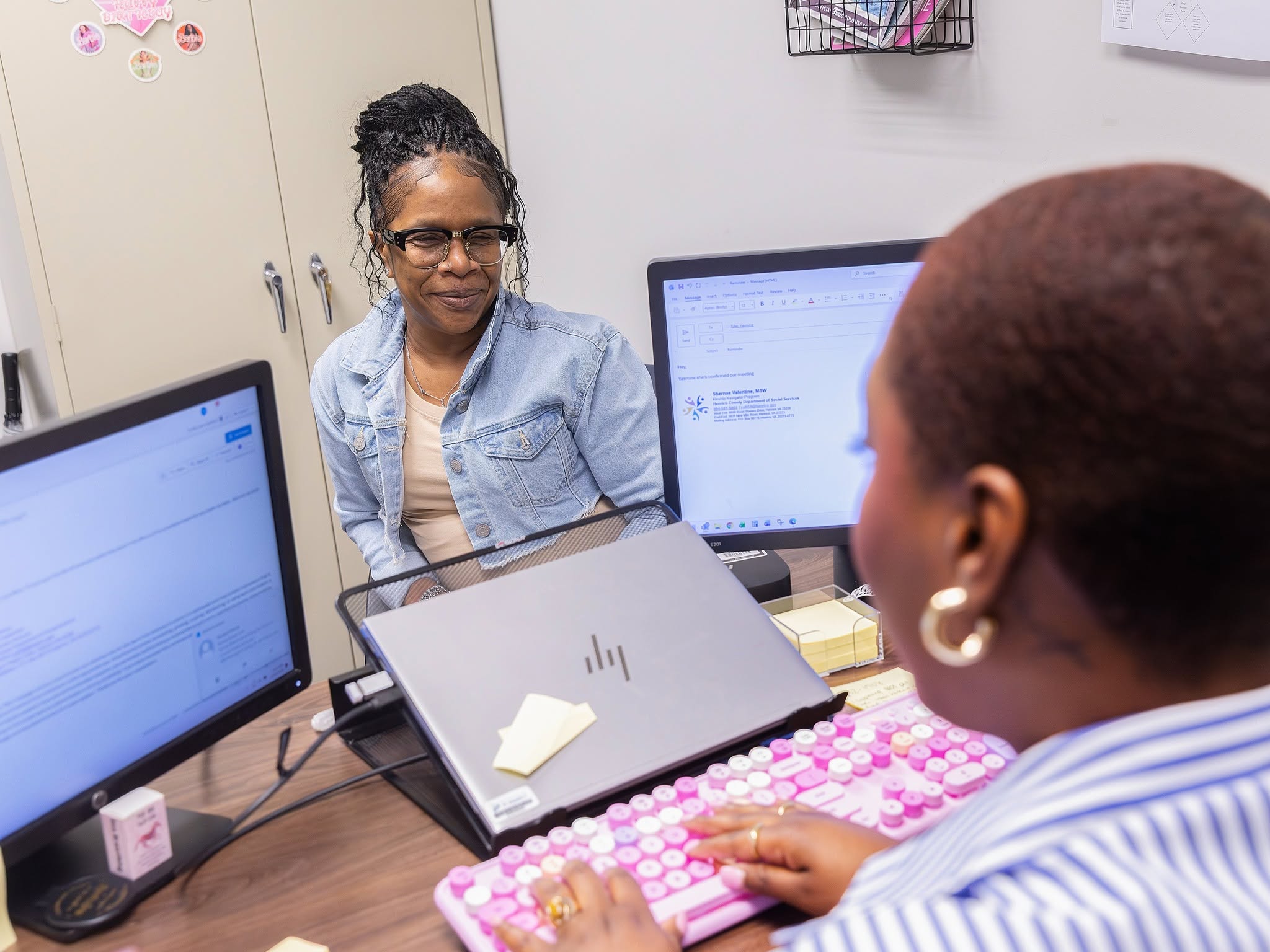
"Navigation does not always look like one thing for another family,” said Shernae Valentine, Kinship Navigator with Henrico County. “Sometimes it's navigating the school process — helping a caregiver get a kid enrolled in school. It could be navigating the social services world, which is very complex and overwhelming at times. Sometimes navigating is me showing up physically and being next to someone and saying, ‘okay, this is the next step that we have to take to get here.’"
For families already in crisis, the bureaucratic weight of the child welfare system can be its own form of trauma. Courts, paperwork, hearings, benefit applications — each one a barrier between a family and stability. A navigator removes the barriers one by one.
"I would have had to learn how to do all this — going to the courts, doing the paperwork, getting everything together,” said April Estel-Wilson, a caregiver. “They just made the process easy. They work behind the scenes for my good."
A Less Traumatic Path — for Everyone
The benefits of kinship care don't stop with the child. They extend to the birth family — including the parent working toward recovery. When a mother in treatment knows her child is with her own mother or a friend, not a stranger, something shifts. The obstacle of the unknown is gone. The path back becomes clearer.
"The hope is that this being a less traumatic experience, not only for the child, but for the birth family — for these parents to be able to trust that their parent or their sister or brother are raising their child temporarily — that they're going to be able to make better progress in their treatment, to be able to reunify with their children," Brown said.
That theory is proving out. The program is seeing not just kinship placements hold — it is seeing families come back together.
"We are actually seeing a lot of success,” Brown said. “We're not just seeing relatives permanently caring for foster children, but we're seeing reunification with the birth family happen much quicker — because one of the obstacles of working with a stranger has been eliminated from that process."
The Longer Vision
The Kinship Navigator program is designed to do more than help individual families. It is designed to change a community’s relationship with the children in crisis within it.
“This Kinship Navigator (program) is going to have an opportunity to challenge our community to step up differently by sort of modeling what that behavior looks like to support kinship families,” Brown said. “The broader impact is going to be, over time, a reduction in the number of children that enter foster care.”
There is a direct line between a parent in recovery, a child placed with a grandmother who already loves them, and a community that never had to absorb one more family lost to the system. The Kinship Navigator program exists at that intersection — where the right support, given at the right moment, holds a family together long enough for healing to take hold.
“We know that these families, they’re in crisis and they need additional support, and that’s where our resources should really be going,” Carpenter said. “We should care about providing that extra layer of support to them.”
This is what it looks like to use opioid abatement funding not just to treat addiction, but to protect the children left in its wake — and to keep those children where they have always belonged: with somebody who already knows them. Somebody who already loves them.
The Henrico County Kinship Navigator program was made possible through a Virginia Opioid Abatement Authority award to Henrico County.